
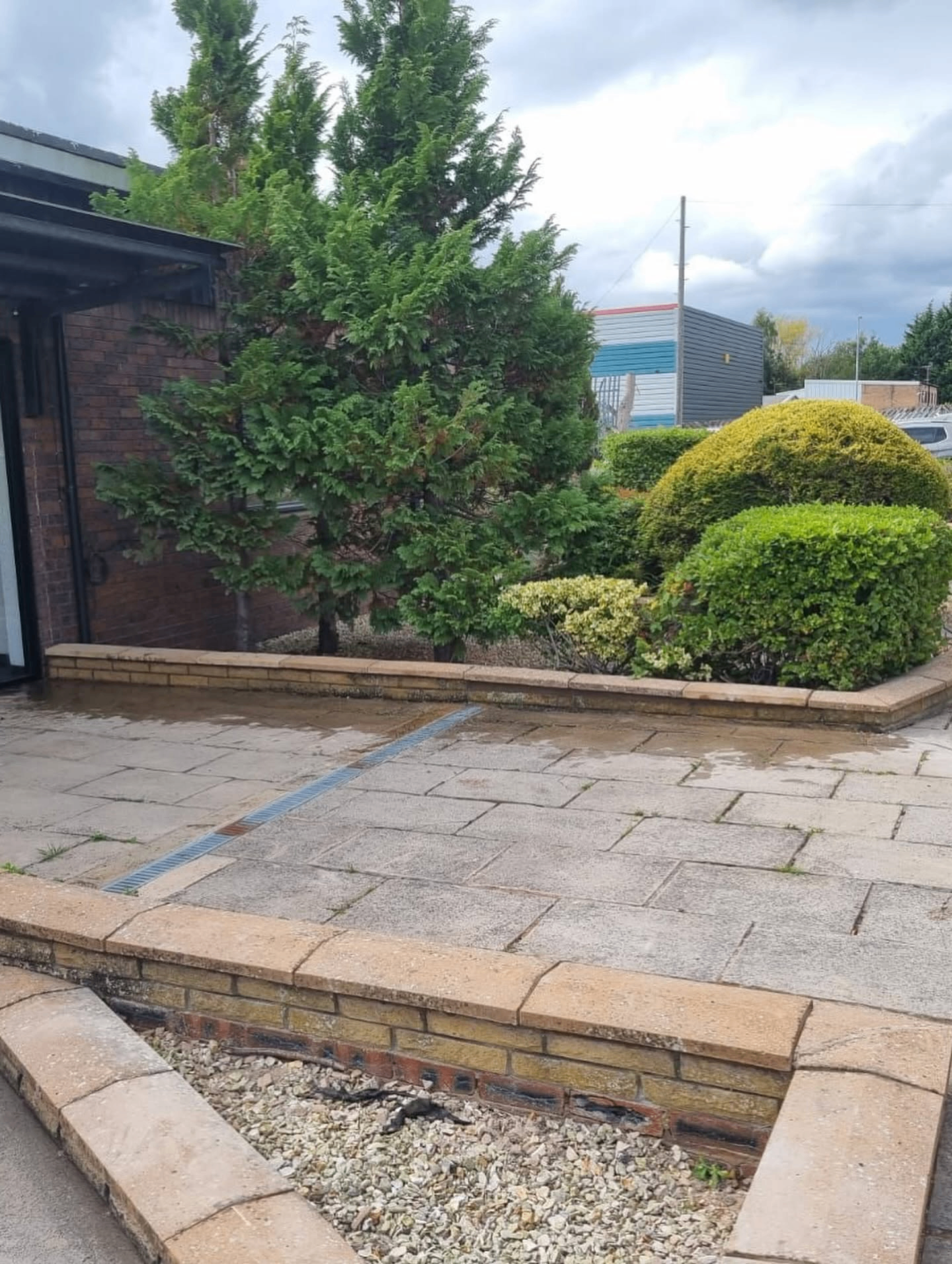
Planting & pruning
Planting and pruning that
actually moves a site forward ,
season after season.
Structural pruning, seasonal planting, shrub care and shaped hedging that takes a tired site and gives it identity. Communal blocks, frontages and commercial grounds, designed, planted and maintained by a crew that knows what survives a North Wales winter.
RHS-trained crew · 14+ years on the tools · Full grounds maintenance under one contractor.
Service overview
Planting & Pruning in North Wales & the North West, what you actually get.
What it is
Seasonal planting (spring bedding, summer perennials, autumn bulbs), structural shrub and tree pruning, formative pruning on young plants, restorative pruning on tired shrubs, hedge reshaping, mulch top-up and bed preparation. Both as one-off projects and as a planned component inside a wider grounds maintenance contract.
Who it's for
Block managers wanting frontages to actually look like someone designed them. Letting agents preparing properties for sale or remarketing. Commercial sites that need year-round colour at the entrance. Developers handing over completed schemes that need a planting plan executed. Residential landlords wanting kerb appeal without buying it back every two years.
When you need it
Most planting is seasonal. Spring bedding goes in late April to early May once frost risk fades. Summer perennials and shrubs ideally planted late September to early November so roots establish over winter. Bulbs planted October to early December. Pruning timing matters even more, wrong time of year and you remove next year's flower buds or expose the plant to die-back.
Why it matters
Generic 'gardening' costs money without ever moving a site forward. The grass gets cut, but the beds slowly die, the hedges go hollow, and three years in the site looks worse than it did at the start. Planned planting and pruning is what compounds, every year the structure improves, the colour improves, and the cost-to-keep stays flat.
What happens if you wait
The real cost of leaving it.
The most expensive plants you'll ever buy are the ones you replace because the first lot died. Wrong species for the site, wrong time of year, wrong soil prep, wrong pruning timing, every one of those mistakes burns the budget twice over.
Risks of leaving it
- Hedges left unpruned past 18 months go hollow at the base and can't be cut back to size without leaving bare wood.
- Wrong pruning timing on flowering shrubs (e.g. cutting buddleia in spring instead of late winter) removes the entire flowering season.
- Bedding planted too early gets killed by late frost; planted too late, it never establishes before summer drought.
- Tired beds without mulch top-up dry out, weeds set in, and the planting budget gets eaten by re-prep next year.
- Topping trees instead of properly thinning them creates weak regrowth and storm-damage risk that the freeholder ends up paying for.
- Self-seeded saplings in commercial frontage grow into structural problems within five years, by then it's a tree surgery job, not a hand-pull.
Common mistakes we see
- Buying plants from a generic retail garden centre instead of a trade nursery, wrong size, wrong root preparation, wrong species selection.
- Planting into compacted clay without prep, root systems can't establish and the plant fails within a year.
- Pruning everything 'back to size' once a year, destroys flowering, fruiting and structural integrity.
- Ignoring soil pH and aspect when choosing species, sun-lovers stuck in deep shade, ericaceous plants in alkaline soil, and the bed looks half-dead by year two.
- Mulching with bark over weeds instead of clearing first, buys six months, costs a full reset.
- Treating planting as decoration rather than infrastructure, and then wondering why nothing's there in five years' time.
Our process
How we deliver, step by step.
- 1
Site assessment
Aspect (sun/shade), soil type, drainage, existing planting, identification of anything worth saving vs anything past its life. Photographed and noted so the design has a starting point.
- 2
Planting & pruning plan
Written plan covering species, locations, timing through the year, and a structural pruning calendar for what's already on site. Costed across the year, not as one big invoice.
- 3
Bed preparation
Existing weeds cleared by root, soil dug over to a spade's depth, organic matter or compost worked in, edges defined. Done properly so the planting has somewhere to live.
- 4
Planting
Plants positioned dry first, adjusted for spacing and sight lines, then planted at the correct depth, firmed in, watered in and mulched. Trees and larger shrubs staked where wind exposure requires it.
- 5
Establishment care
First-season watering visits during dry spells, weed clearance in beds before they set, and any necessary protection (rabbit guards, wind shelter) maintained until plants stand on their own.
- 6
Annual pruning calendar
Each species gets pruned at the right time of year for its growth pattern, winter for structural, post-flowering for shrubs, late winter for buddleia and similar. Visits scheduled into the wider maintenance contract.
What you get
The benefits, in plain English.
Plants that live past year two
Right species, right prep, right time of year, the plants establish and stay established.
Sites that improve, not erode
Year-on-year structure gets stronger, colour gets more confident, and the maintenance budget stays predictable.
Real kerb appeal
Frontages that look designed, not 'mowed and forgotten'. Particularly important on rental and commercial properties.
Storm-safe pruning
Trees thinned properly, weak branches removed before they fall, no risky topping. Insurance-friendly, freeholder-friendly.
Year-round interest
Planting plans built so something is in season every month, not just a summer flush and nine months of green.
Inside one contract
Same contractor as your grass cutting, hedge care, fly-tip cover and reactive maintenance, one invoice, one account manager.
The detail that matters
Planting & Pruning: materials, methods & specifications.
Plants behave like the site treats them. Get the early decisions right, species, soil, timing, pruning, and they look after themselves for decades. Get them wrong and you're rebuying the same shrub every three years. Here's what 'getting it right' actually means in practice for the kinds of sites we look after.
Species selection for North Wales conditions
Coastal North Wales, the Cheshire flatlands and the Pennine fringes around Manchester all have different wind exposure, frost windows and rainfall patterns. We don't plant a Mediterranean specimen on an exposed Rhyl seafront, and we don't plant moisture-lovers on free-draining Wrexham gravel. Species chosen for the site, not the picture in the catalogue.
Soil preparation
Compacted ground gets broken up and amended with organic matter; heavy clay gets grit and compost worked through to improve drainage; thin sandy soil gets bulk added so roots have something to hold. Prep is the cheapest hour of the project and the one that decides whether the planting survives.
Structural pruning
Mature shrubs and trees benefit from formative cuts, removing crossed branches, weight reduction on heavy laterals, opening the canopy for light and air. We never 'top' trees (it produces weak, dangerous regrowth) and we never cut back to bare wood unless restoring a hedge that has no other option.
Formative pruning on young plants
First three years of a hedge or shaped shrub set the structure for the next thirty. Cut wrong in year one and you're managing the result forever. We prune young hedging hard in the first two seasons to drive density at the base, counter-intuitive but it's the only way to avoid bare-stem hedges later.
Seasonal bedding
Spring bedding (pansies, primulas, polyanthus) goes in late autumn or very early spring; summer bedding (geraniums, busy lizzies, petunias) goes in once frost risk passes in late April / early May; autumn bedding (cyclamen, ornamental cabbage) takes over from October. Useful for high-visibility entrances and frontages, less useful inside maintenance budgets for tenanted blocks.
Bulb planting
Spring bulbs (daffodils, tulips, crocus) planted October to early December at three times bulb depth, in groups not lines, and left to naturalise. Cheapest long-term colour-per-pound on the market, single planting gives 10+ years of return with almost no ongoing cost.
Mulch & weed suppression
2–3 inches of bark or compost mulch top-up across beds every spring suppresses weeds, retains moisture and feeds the soil as it breaks down. We weed before mulching, never over the top of existing weeds, that's where most 'mulched' sites fail.
Tree care & TPO awareness
We check Tree Preservation Order status before any tree work, regardless of how routine the prune looks, local authority consent is required and a non-consented cut on a TPO tree carries serious fines for the landowner. Conservation Areas have similar restrictions. We handle the application paperwork as part of the quote.
Every planting and pruning programme is delivered alongside our wider grounds maintenance contracts, but available as a standalone project where you already have a gardener but need a one-off reset.
We cover North Wales, Wrexham, Rhyl, Bangor, Cheshire, Liverpool, Manchester, Lancashire, Cumbria, see our full service areas or jump back to home.
FAQ
Honest answers, before you call.
Do I have to commit to a contract for planting work?
+
No. We deliver one-off planting projects, frontage refreshes and one-off pruning resets without any maintenance commitment. Most clients move into a maintenance contract afterwards because keeping new planting alive needs follow-through, but it isn't required.
What's the best time of year to plant?
+
Late September to early November for most shrubs, trees and perennials, the soil is still warm, autumn rain establishes roots, and the plant is dormant by the time hard frost arrives. Spring is the next-best window. Summer planting is possible but needs intensive watering.
When should hedges be pruned?
+
Depends on the species. Most evergreen hedges (privet, laurel, box) take two cuts a year, late spring and late summer. Beech and hornbeam take one cut in August. Conifer hedges should be lightly maintained yearly and never cut back to bare wood.
Can you prune protected trees?
+
Yes, but we check TPO and Conservation Area status first, and submit any local authority applications required before work starts. Unconsented work on a TPO tree carries fines up to £20,000, so it's worth getting right.
How much does a planting plan cost?
+
A small frontage refresh starts around £400–£700 including plants and labour; a full block-entrance redesign with bedding rotation runs £1,500–£3,500 depending on scale. Site survey and plan can be quoted standalone if you want second opinions before committing.
Will you guarantee the plants will live?
+
We guarantee the work and the species selection. Plants are living things, we replace anything that fails through poor stock or planting technique in the first 12 months. Failures from neglect, drought, vandalism or non-watering are excluded but we'll always look at the cause honestly.
Do you offer ongoing pruning visits?
+
Yes, built into our standard grounds maintenance contract, or as a standalone twice-yearly pruning programme priced per site.
Do you cover commercial frontages and signage planting?
+
Yes. Hotels, offices, retail parks, industrial estates, anywhere the frontage matters to footfall or first impression. We work to colour-rotation calendars that keep entrance beds in season year-round.
Ready when you are
Free survey, fixed written price for your planting & pruning on the day we attend.
No pressure, no obligation. A senior tradesperson attends, diagnoses properly, and hands you a fixed written price on the day of the site visit.
Related services
Often paired with planting & pruning.
Landscaping & Grounds Maintenance
Commercial and residential landscaping across Deeside, North Wales and the North West, grass cutting, hedge trimming and grounds maintenance on a fixed schedule. Call 01244 529900.
Learn moreCleaning Services
Communal area, end-of-tenancy and commercial cleaning across Deeside, Chester and the North West, properly inspected, properly documented, properly priced. Call 01244 529900.
Learn moreFly Tip Removal
Licensed fly-tip removal across Deeside, Wrexham and the North West, sites cleared, photographed and reported, often the same day. Call DMS on 01244 529900.
Learn more